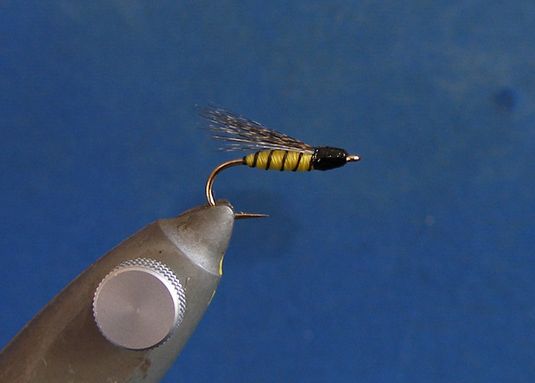
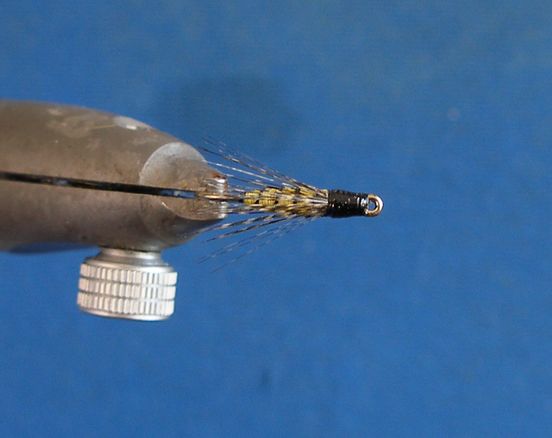
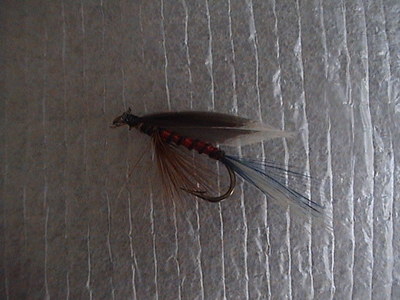
Здрасти Ванка.
Цитат:
Аз ще покажа една,не и знам името.Оригинала,го бях купил доста преди да се уча да връзвам
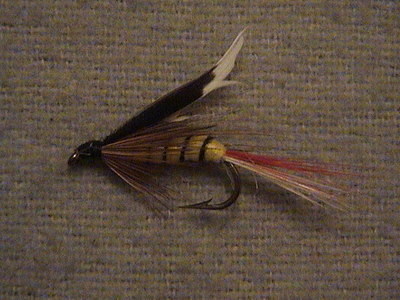
Това е една от наи-известните мокри мухи имитиращи пчели,името и е McGinty Bee.
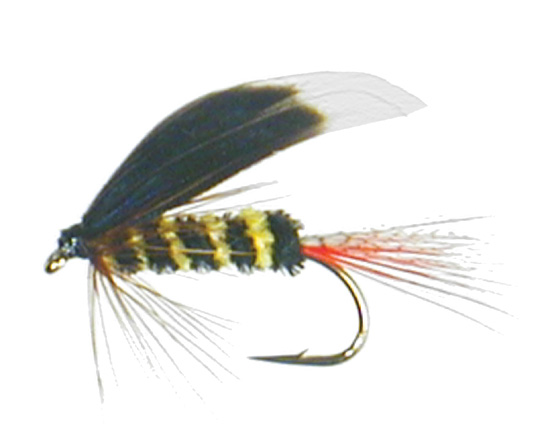
Ето един интересен разказ за нея от Гари ЛаФонтен
Цитат:
August 1954; Windsor, Connecticut
This isn't just about the McGinty (a pattern you would have trouble finding in any modern fly shop), but about all bee and wasp imitations, wet and dry, the new innovative creations. Many of these patterns, tied with synthetics, are great trout catchers. Dry flies such as the Harrison Steeves Bumble Bee and the Andy Burk Yellow Jacket, along with my own , are durable and high floating; and I'll often fish a dry fly/wet fly combination, pairing one of these modern flies with a McGinty dropper.
Mysteries? Why does a McGinty always work after a quick afternoon rainstorm? Why is it usually such a lousy fly the rest of the time? The McGinty is a garish pattern, with a body of alternating black and yellow chenille, a tail of gray mallard fibers topping a few wisps of scarlet fibers, a wing of black turkey feathers with white tips, and a brown hackle, but it works at the right moment on a trout stream.
The McGinty was the fly that I caught my first fish on with a fly rod when I was nine years old.
The flimsy three-cent McGinty wet fly was the pattern I fingered out of the fly box, even though I had never gotten a strike on it in all my days of fishing Mill Brook that summer. It was the reason I was crouched there next to the water in a blood-soaked shirt with a swelling, blackening lump over my right eye. The short, rainstorm was over, but the water was soaking through the maple leaves, getting me wet and making the shirt stink with the blood. I thought about taking it off and washing it out in the stream, but then a fish rose in the pool above me.
I couldn't cast very well, and I had never caught a fish on my fly rod. This was my twenty-eighth straight day on Mill Brook, the closest trout stream to my home. This was a summer of a lot of hours flogging water with a fly rod, an instrument so strange for a nine-year-old with no one to teach him how to use it. All I had were books and magazine articles. And little containers of cheap Japanese flies that came in round, plastic boxes with lids that lifted up and rotated to expose the various sections.
To get from my home to Mill Brook at the far end of Windsor you had to take two buses, with one transfer that took the passengers all the way back to the edge of Hartford. I sat there at the bus stop, the old Fuller Brush plant behind me and Kenney Park stretching out across the street. It was a busy area, a city work crew paving the road, a group of boys lounging around the bench, women from the factory lining up at the gate. While I was waiting for the bus, I took out the round box of Japanese wet flies, a selection that always contained patterns such as the Royal Coachmen, Black Gnat, Scarlet Ibis, and McGinty. The whole set of a dozen flies cost twenty-five cents, and mostly on Mill Brook I was losing them in the tree branches above me. Lately though I was getting pretty good about missing tree limbs with my back casts, and except for the two flies I had broken off on trout, the Japanese wet flies were coming unraveled all by themselves after enough hours of my whip lash casting.
Long before I learned how to tie flies I learned how to repair them. My mother showed me how to use her finger nail polish to coat the head of the fly and strengthen the wraps. Sitting there on the bus bench, I noticed that the thread was unwinding on the head of the McGinty, so I took out my bottle of finger nail polish, Passion Rose. One of the boys sitting by the bus stop bench called to his buddies, "Hey, look at the little fairy with the finger nail polish."
I didn't know what to put away first, the McGinty or the Passion Rose polish. There were four of the boys, slightly older and slightly bigger. There really wasn't much use talking when you're sitting on a bus bench in Hartford holding a bottle of Passion Rose finger nail polish. I stood up, I smiled at the lead boy and said, "Hi, my name is Sally Ann," and I punched him.
What are you going to say when you are holding a McGinty and a bottle of Passion Rose finger nail polish? The punch was a good one and as he lurched forward blood gushed from his nose all over my shirt. His swings were wild, but he was so much bigger and stronger than me that a punch that caught me on top of the right eye drove me against the bench. I got back up and waited for him to come towards me. Two good hooks to the belly and he was on the ground.
There was a moment when not much happened, the friends of the boy on the ground just circling closer and the people at the bus stop turning to watch. The city road crew put down their tools, crossed the work barrier, and walked over to the curb. One of the boys who was standing helped the one on the ground get up to his feet.
One of the boys yelled, "Get him," but then one of the city road workers stepped forward and with a black hand that was meant to grab the back of his neck, but actually wrapped around his head, neck, and most of his two shoulders, he jerked the boy high into the air.
"Actually," the black man said, "I think a man looks good in finger nail polish. Don't you?"
Dangling boy squeaked, "Yes, sir," then the black man threw him away like he was tossing away a piece of trash.
The black man said to me as he was turning away, "That's because you're Benny's friend."
"How do you like that?" I said. "Those kids ran away and never even thanked you for saving their lives. Lucky for them you were here."
The trout rose fifteen feet above where I crouched on the stream bank. I tied the #12 McGinty on the gut leader, made a sidearm cast that missed the tree limbs, and dropped the fly just above the fish. He took it with a flashy enough strike that even I, in my quick bumbling, couldn't miss, and he wasn't so big that I could break him off. He was a perfect nine inches, a jumping rainbow that kept bouncing until I dragged him to my net.
That same fish, certainly a wild, stream-bred trout spawned in the springs at the upper end of the brook, stayed in the pool the rest of the summer. He never took a McGinty again, but he struck a Black Gnat once at dusk. My fishing skills with the fly rod kept getting better, and I caught eight more trout before fall, but none of them on the McGinty. And I used the McGinty plenty of times that summer.
It was four years before I caught another trout on a McGinty. By then I was carrying a lot of wet fly patterns and using them skillfully in both lakes and streams. Out of nostalgia, if nothing else, I'd take out the McGinty and try it frequently. Some of my favorite wet flies, such as the Quill Gordon and Leadwing Coachman, tallied thirty or more trout a season, but I had so little faith in the McGinty that I usually snipped it off my leader after fishing it for a few minutes and not catching anything with it.
One afternoon I was on the Battenkill River in Vermont. The big brown trout in this stream were too tough for me - my skills as a thirteen-year-old were still at the brook trout stage. And even then those fish had to be in the rougher, broken-water sections of the river. I was playing with a 2-fly setup, trying to learn a new method of wet fly fishing. I was fishing a Leadwing Coachman on top and a McGinty on the end with an across stream cast and a mend-mend-mend, sequence. The two flies were drifting broadside with the current down a riffle. The Leadwing Coachman caught trout, one brook trout after another, and even a few small brown trout, nothing over ten inches, but lots of fish. The McGinty caught nothing.
The hot day turned nasty, and with a quick burst of thunder it started raining. I sat out the storm inside an old covered bridge, and then since I had to walk back up river to go back to the cottage anyway, I waded the riffles and cast with the two flies. The presentation with the Leadwing Coachman and the McGinty were different—now it was a straight upstream cast like a dead drift nymph. It wasn't something I knew how to do. I was just doing it. Then suddenly I had a fish on my line, but it wasn't one of the small brook trout. I fought the trout downstream, stumbling into the bank to beach her, and I saw my first large brown trout on the river. The sixteen inch female had the McGinty in the top of her mouth.
I kept fishing up the river, but unlike before the rainstorm most of the trout were now taking the McGinty instead of the Leadwing Coachman. Just to test the preference of the fish for these flies I turned around and tried the across-stream method, and the trout still liked the McGinty better than the Leadwing Coachman. The preference wasn't as absolute as it was with the upstream dead drift presentation, but it was still at least 5 to 1 for the bright bee imitation over the dark peacock coachman variation. With the upstream presentation the McGinty caught lots of brook trout, many medium-sized brown trout, and three more large brown trout. The wet fly that couldn't catch anything was suddenly the miracle fly that made a thirteen-year-old dub the master of the mighty Battenkill for one afternoon.
Of course, the McGinty never caught another decent trout from the Battenkill during our summer vacation It never did rain hard again for the last three weeks of our stay in Vermont.
It's fun to watch a trout's reaction to a sunken, black and yellow fly while scuba diving on a sunny day in a clear stream. The fish approaches the fly, drifts back with it as it travels in the current, even comes close enough to nip it with his lips as if he is afraid of being stung, but he seldom grabs the fly solidly. The bright colors, especially the contrast of black and yellow, instinctively warn the fish.
It's different on a day with a heavy overcast. The sunken bright fly isn't so garish, and the trout respond more confidently. A bee imitation still isn't the main item in the diet with a few clouds - for that it takes rain. Underwater, during and after an afternoon cloudburst in summer, a trout no longer just looks at a black and yellow fly. Now the fish streaks forward, breaking from a feeding lie to snatch a prime piece of food before any other fish can get it. This doesn't happen on all streams. Only on ones where real bees are getting drowned.
My fishing logs are my keys to unlocking the mysteries that haunt me. They take the random incidents from different years - at least a 100 days of fly fishing a year between the ages of 9 and 53 - and create a thread that makes sense. So much of fly fishing for me is understanding the flies—how-to, when-to, and where-to use them. The McGinty isn't a random pattern, a fly you just tie on and fish anywhere and expect to catch trout.
The McGinty was my first fly. The McGinty haunted me; and I didn't understand the mystery until I spent hours in a library with piles of books about bumble bees. Bees fly in warm weather, gathering pollen to make honey. With the approach of a storm, they begin returning to the hive, but the sudden wind and rain of a summer thunderstorm causes high mortality. Around meadow streams with large populations of honey bees, large numbers of these insects are either knocked or washed into the water. It's the large number of bees in the drift that make the trout start feeding on them, at first tentatively but then more and more enthusiastically. The heavier and more sudden the rainstorm, the more effective the McGinty becomes on a trout stream, especially when there are honey bees in the surrounding meadows.
The McGinty, or any other bee imitation, is a fly that I'll use five or six times a season. It has produced some of my greatest days of fishing on waters all over the country.
— Rock Creek, Montana; right at the mouth, where it enters the Clark Fork River, on September 25th. The big browns were migrating up Rock Creek to spawn, and just below Valley of the Moons Bridge after an afternoon thunderstorm, the fish couldn't leave an upstream dead drift McGinty alone. The fly caught 32 trout in three hours, including 6 over 16 inches.
— Musconetcong, New Jersey; on July 7th, against the bank, where a fallen log created a long, deep hole. The rainstorm had ended and the water was taking on a tinge of color. I was using two flies, a McGinty on top and a Rube Wood on the bottom, and tossing both of them straight upstream. There were branches hanging in the water and the flies worked deep under the snags at the head of the hole. The first strike was hard and the fish was an 18 inch brown. A second drift through the same spot, and a second strike in almost the same area caught another brown trout, a 17 inch fish. Both trout hit the McGinty. It was strange to catch two large trout in an area so close together, but they must have been close together because of the thick cover of the snags.
— lower Sacramento River, California; on October 19th, floating the big water, on a rainy day when the fishing was so great that I started switching flies just to see what would work and what wouldn't. My oarsman, Tory Stosich, was too young to have ever seen the old style wet fly - he was a master of every modern method. He took my rod with three McGintys strung on the leader and fished them with an across stream drift. He caught trout for four hours straight, more fish than he would have caught with nymphs, dry flies, or streamers. His biggest fish was a 26 inch brown trout.
Those original wet flies that were in the cheap Japanese selections are still important patterns in my fishing. Its strange sometimes when I'm on a stream such as the Delaware in New York or the Henry's Fork in Idaho, waters known for fussy trout, places where anglers use modern equipment , innovative methods of presentation, and the latest fly patterns, and I'm in the middle of a crowd using anachronistic wet flies such as the McGinty, Scarlett Ibis, Black Gnat, and Royal Coachman. It causes a problem when I'm catching trout on these flies and people start asking questions about them - its not as if they can run up to the local fly shop and buy a handful of them.
My fly fishing life started with a mystery. It took me a long time to puzzle out the answers for the McGinty, but this one pretty little pattern has an important place in my fly box. It's a wet fly that I fish on trout streams during the summer after afternoon rain showers. The McGinty works best in areas where there are good populations of bumble bees. The best method of presentation is upstream dead drift. For some reason, on my flies the ones that work best are the ones where the heads have been touched up with Passion Rose fingernail polish.
Поздрави.



 Влез
Влез Регистрация
 Въпроси/Отговори
 Търсене


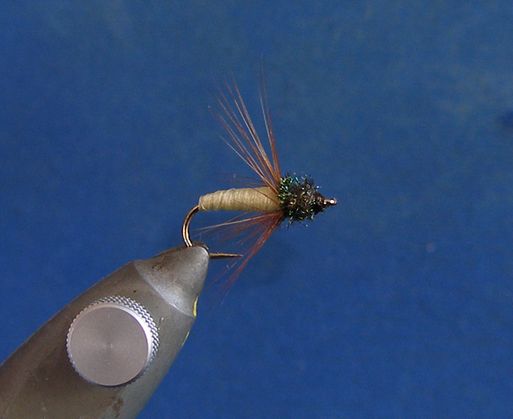
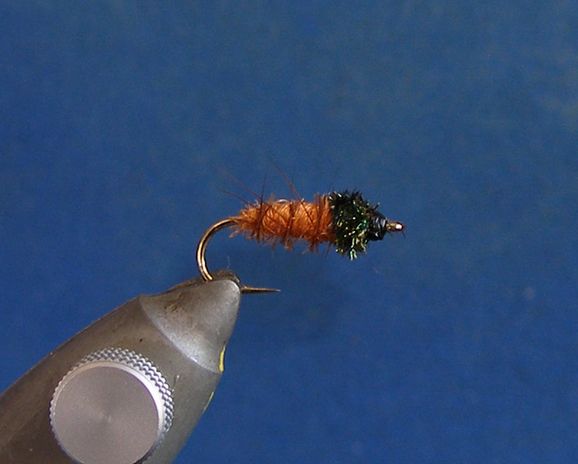
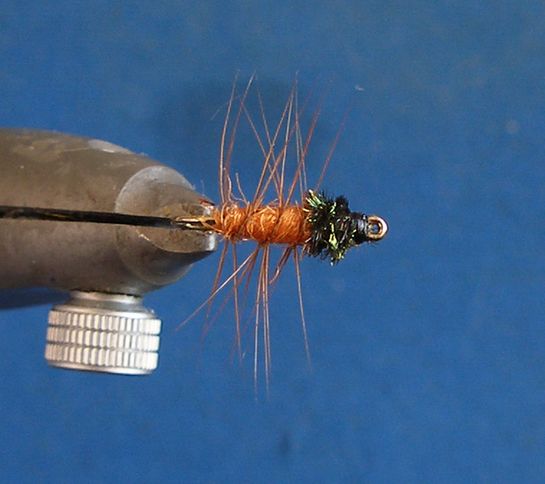
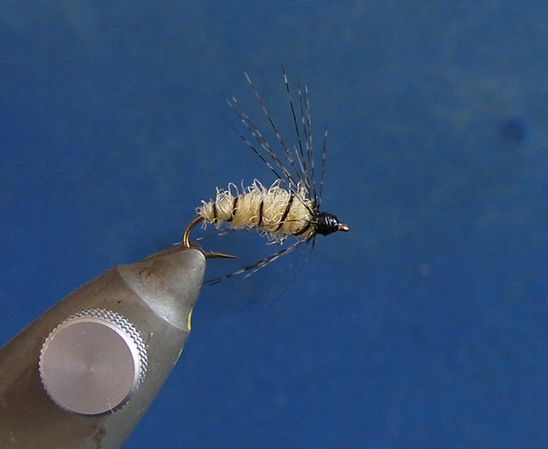
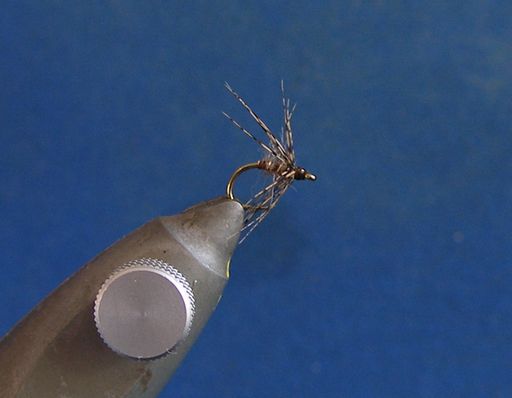
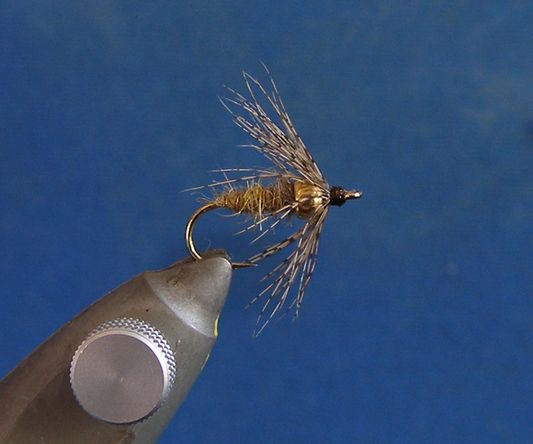


 .Несъмнено има много вариации на един вид мокра муха,както и Alder-a,който е показал Стоян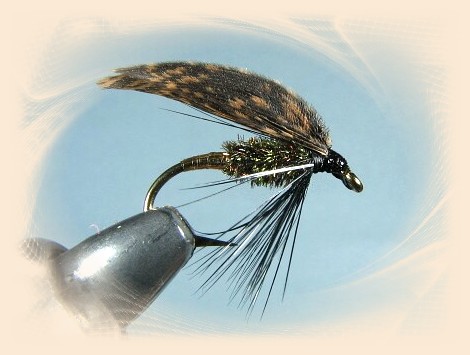
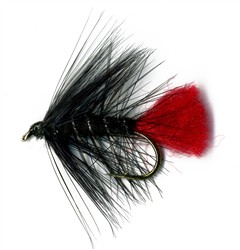
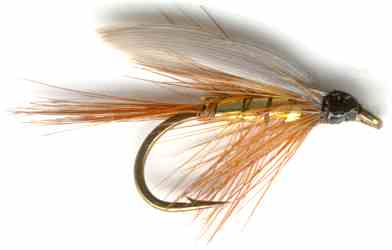 caddis wickham's fancy.